Note the time
Write down when the contact happened and what kind of contact it was. An approximate time is still useful.

Concerned about a possible HIV exposure in Hisar? Dr. Yuvraj Monga runs a confidential teleconsultation line for patients across the city's sectors and colonies - a careful risk assessment, prescription guidance when the situation calls for it, and a plan that fits around your schedule, factory shift or not, with zero judgement.
72 hours matters
PEP is time-sensitive. Contact a clinician now.
Prescription-led
A doctor assesses whether PEP is right for you.
Discreet by design
Teleconsultation and medicine coordination support.
01 / Understand the window
It is: when did the possible exposure happen?
If it may have been within 72 hours, arrange an urgent assessment today.
PEP is not a home remedy or a substitute for testing. A qualified clinician must decide whether it is indicated.
Post-exposure prophylaxis (PEP) is a short, prescription-only course of antiretroviral medicines considered after a possible exposure to HIV. It is designed to reduce the chance of infection establishing after an exposure, but it is not a guarantee and it does not replace medical assessment. The decision depends on the type of contact, whether potentially infectious fluid was involved, the time elapsed, the source status when known, your medical history, kidney and liver considerations, allergies, current medicines and access to follow-up testing.
Timing matters because PEP is an emergency prevention option. It is generally considered for exposures within 72 hours and is most effective when started as early as possible. If you are unsure whether the contact was risky, do not try to calculate a percentage from an online post. Share the facts privately with a clinician. Details such as a condom breaking, unprotected vaginal or anal sex, sexual assault, a needle injury or blood contacting an open wound can change the recommendation.
A negative test immediately after an exposure may not tell you whether that exposure resulted in infection, which is why clinicians often recommend baseline testing and a follow-up schedule. PEP medicines also require adherence and review. If 72 hours have passed, it is still worthwhile to speak with a doctor about testing, other sexually transmitted infections, hepatitis, prevention options and support for anxiety. You have not "missed your chance" to receive care simply because one option may no longer be appropriate.
02 / A calm roadmap
The next few hours can feel loud. This simple sequence turns uncertainty into an action plan.
Write down when the contact happened and what kind of contact it was. An approximate time is still useful.
Call, WhatsApp or book an urgent teleconsultation. Do not wait for symptoms or reassurance from a partner.
Answer honestly. The doctor will discuss baseline tests, whether PEP is indicated and how prescriptions work.
If PEP is prescribed, take it as directed for the full course and attend the advised testing and review.
Seek emergency care immediately. Teleconsultation can support your next decision, but it should not delay urgent in-person treatment when needed.
03 / Clinical clarity
Some people experience a flu-like illness after an infection; others notice nothing. Fever, rash, tiredness, sore throat, swollen glands, headache, night sweats, mouth ulcers or weight change can have many causes. They cannot confirm HIV, and their absence cannot exclude it.
A proper care plan uses timing, exposure details and appropriately timed tests - not symptom-spotting. During a consultation, you can also ask about STI screening, hepatitis assessment, condoms and future prevention. The purpose is not to label you; it is to help you make a safer decision with the information available.
Do share
Timing, type of exposure, medicines and allergies.
Do not do
Self-start someone else's medicines or wait for symptoms.
Care is based on context, not guesswork.
04 / What consultation covers
Dr. Yuvraj Monga's consultation is structured to give you an answer you can act on, without unnecessary exposure of your private details.
Consultation fee
Rs. 2,000
A private, non-judgemental conversation about what happened, when and which fluids were involved.
A clinical decision about whether PEP should be considered and what tests are relevant.
If appropriate, a clinician discusses the prescribed regimen, interactions, side effects and adherence.
PEP is commonly prescribed as a 28-day course, with review and testing advice. Take it exactly as prescribed.
Support with confidential testing and medicine coordination where clinically appropriate and available.
Clear guidance on follow-up HIV testing and care for STI, hepatitis or anxiety concerns.
05 / When urgent advice matters
People often seek PEP guidance after a condom break, unprotected vaginal or anal sex, a sexual assault, a needle-stick or sharps injury, needle sharing, blood contact with damaged skin or mucous membrane, or another incident that feels difficult to describe. A recent STI diagnosis or uncertainty about a partner's status may also be a reason to ask for a risk review. The clinician can explain what is and is not a meaningful exposure.
Unprotected vaginal or anal sex, condom failure, or assault should be discussed urgently. Do not delay while trying to identify symptoms.
Needle sharing, an accidental needle-stick, or blood in an open wound needs prompt clinical assessment.
Healthcare workers and anyone exposed to an unknown source should use emergency services where needed and arrange expert advice.
05 / When to ask about PEP
These situations can be reasons to ask urgently about PEP. They do not automatically mean PEP is needed: eligibility depends on the specific exposure, fluids involved, timing, source information and a clinician's assessment.
No condom, condom break or slippage. Share the timing and type of contact without fear of judgement.
Ask a clinician promptly
A partner's status may be unknown. A clinician can help you assess the actual exposure rather than guess.
Ask a clinician promptly
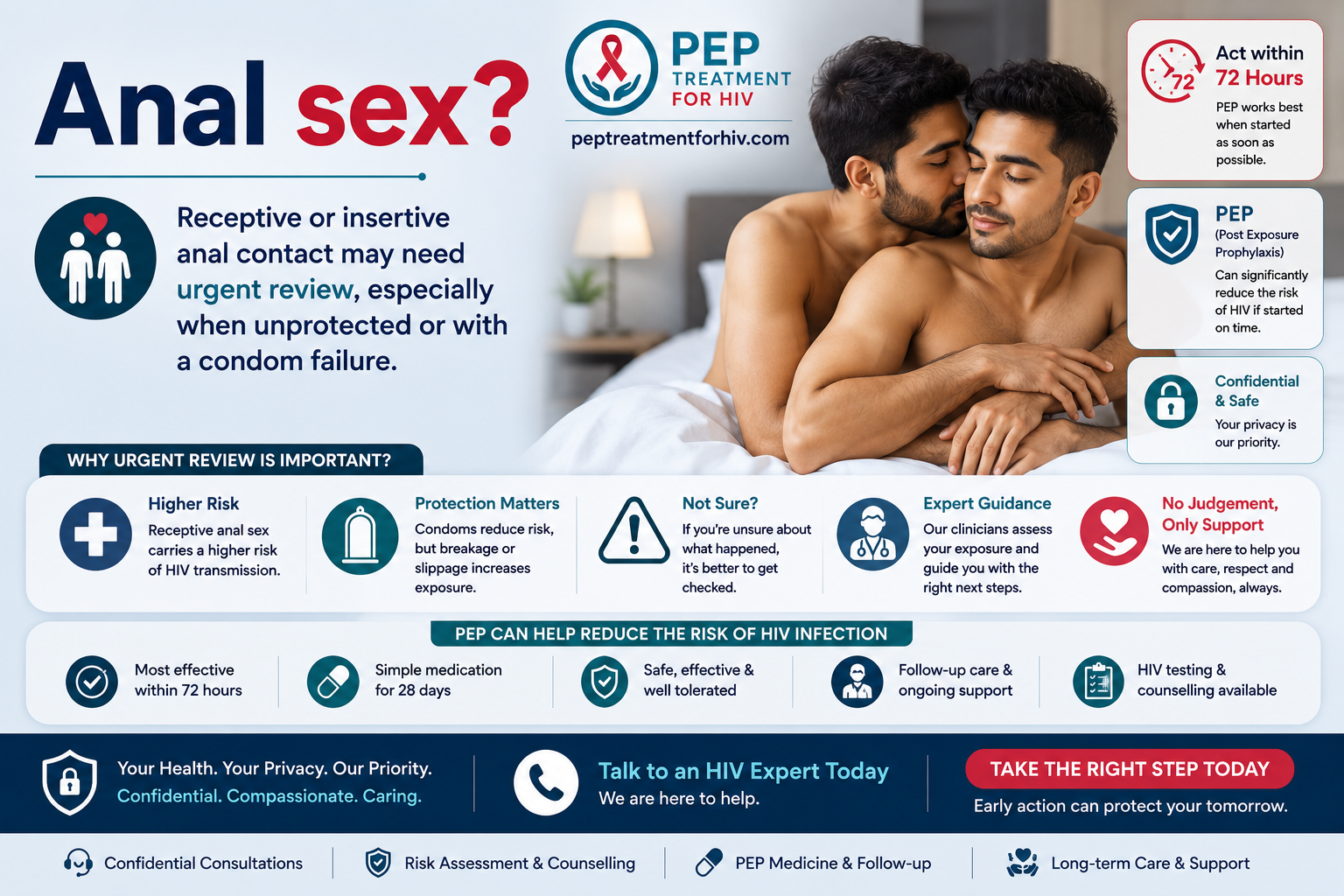
Inclusive, confidential care for men who have sex with men; risk depends on the contact and protection used.
Ask a clinician promptly
Receptive or insertive anal contact may need urgent review, especially when unprotected or with a condom failure.
Ask a clinician promptly
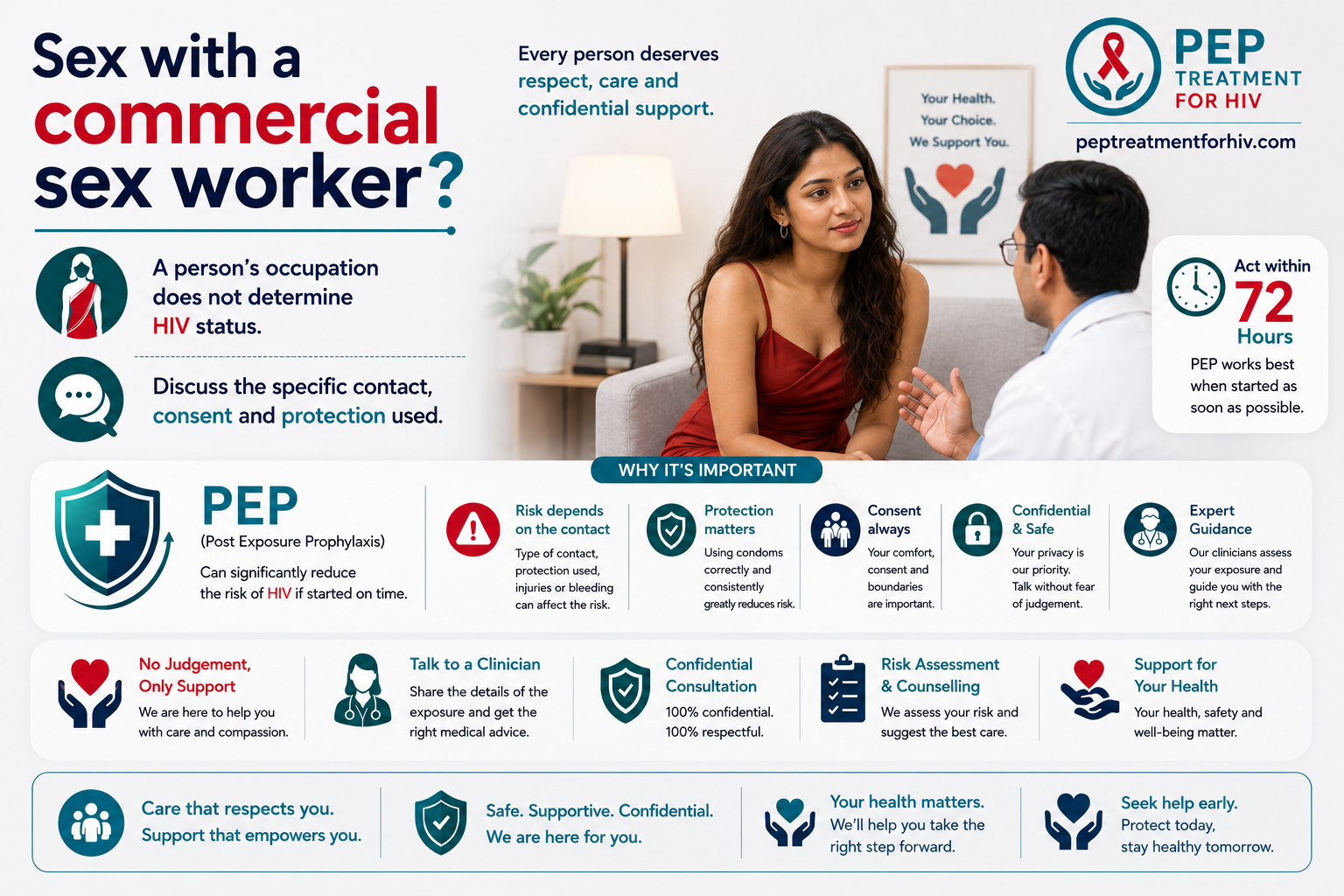
A person's occupation does not determine HIV status. Discuss the specific contact, consent and protection used.
Ask a clinician promptly
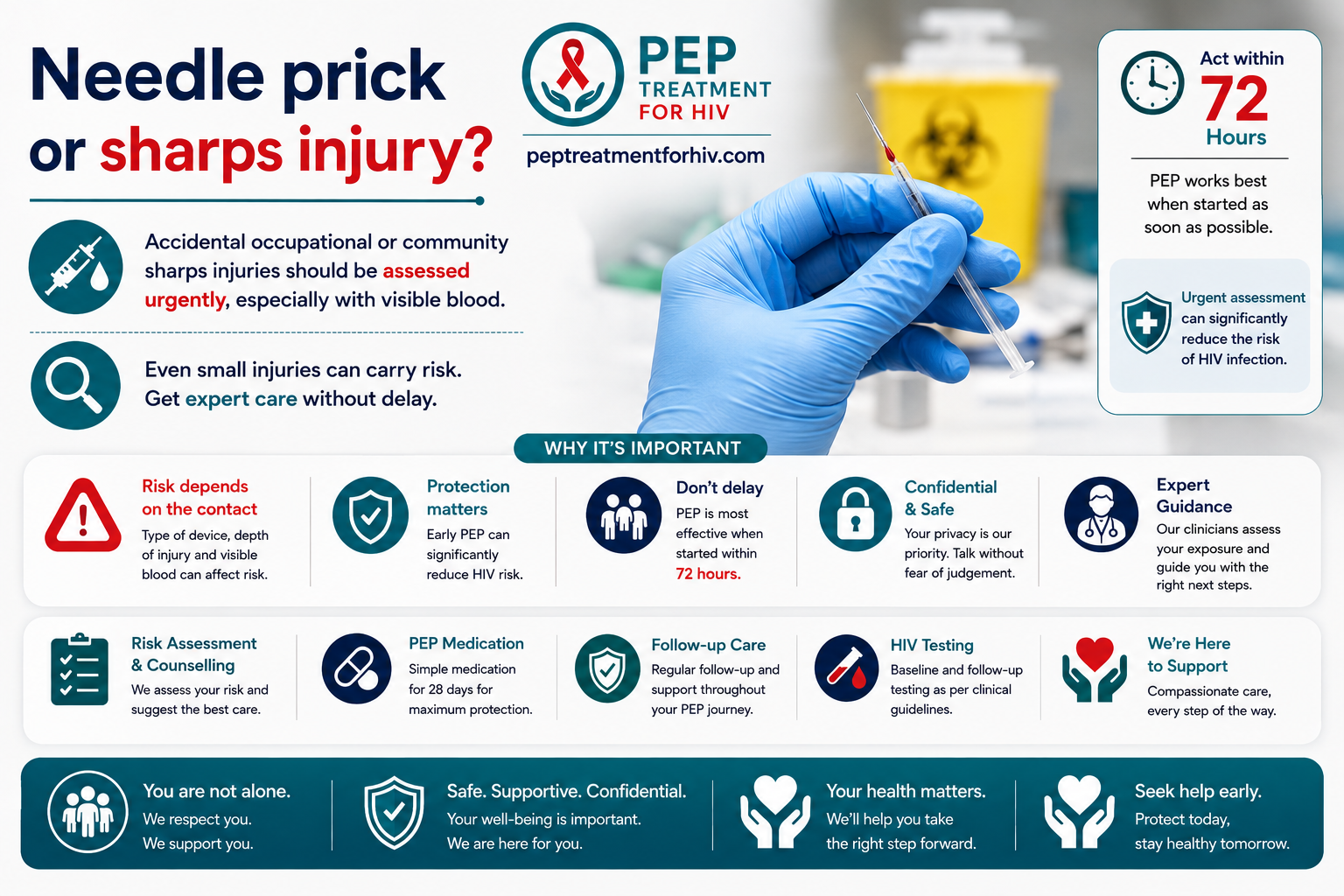
Accidental occupational or community sharps injuries should be assessed urgently, especially with visible blood.
Ask a clinician promptly
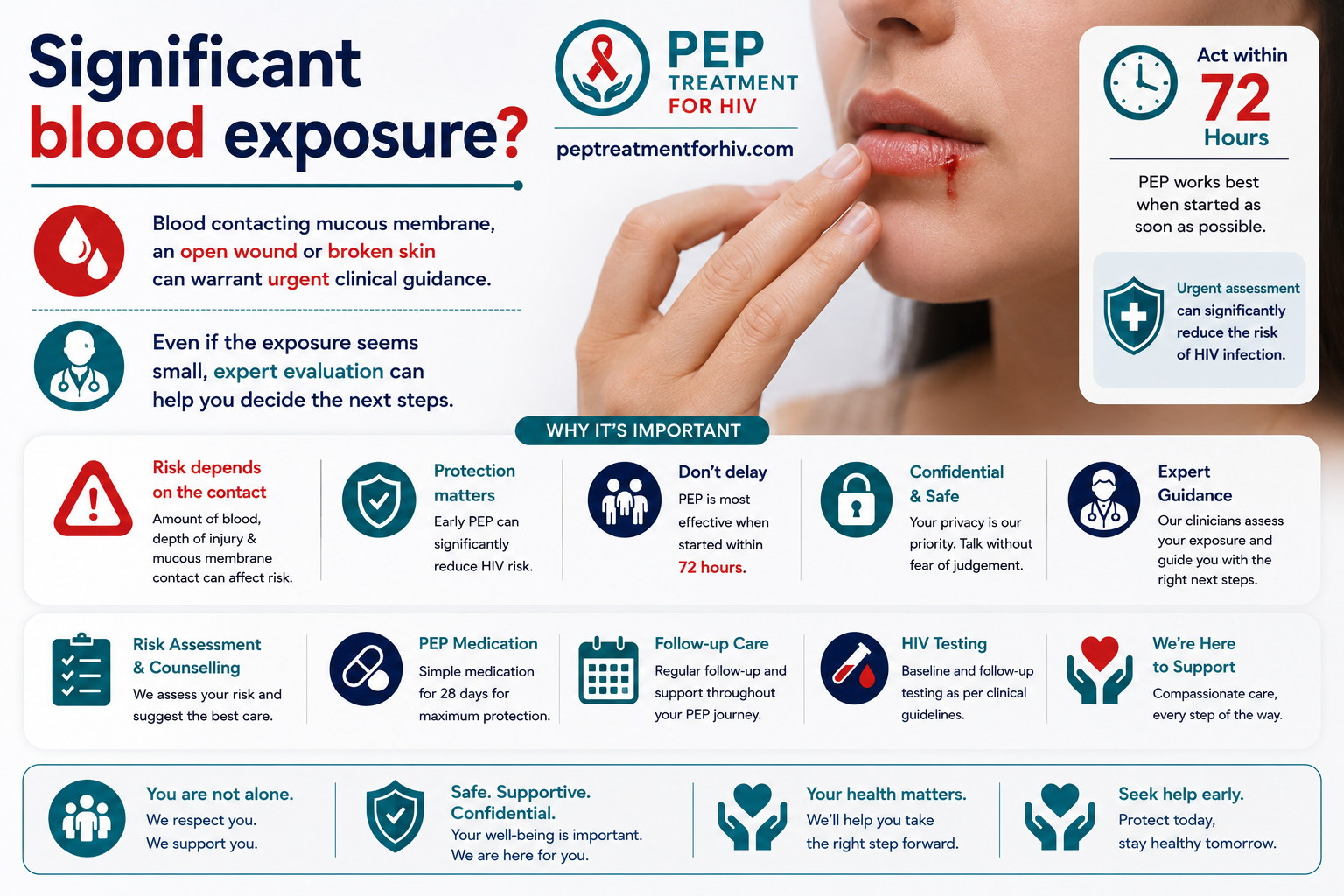
Blood contacting mucous membrane, an open wound or broken skin can warrant urgent clinical guidance.
Ask a clinician promptly
06 / PEP medication and timing
PEP is prescription-only. When a clinician decides it is appropriate, it is commonly taken for 28 days and followed by a testing plan. It is not a guarantee, and it is never a reason to self-medicate or use somebody else's tablets.
Now
Contact a qualified clinician and note the exposure time.
Window
PEP is generally considered only within this time window.
Decision
A doctor checks risk, medicines, allergies and relevant tests.
Course
If prescribed, take the complete course exactly as directed.
After
Complete the testing and review plan advised for you.
07 / Hisar access map
Hisar spreads across numbered HUDA sectors, Urban Estate, and established colonies like Model Town - but there is no separate physical PEP clinic based in the city. Whether you're near Dabra Chowk, Delhi Road, or one of the industrial areas on the outskirts, the first step is the same confidential phone consultation, followed by medicine delivered to your address.
06 / Start privately
This form is for a callback request, not a diagnosis. Please do not share passwords, identity documents or unnecessary sensitive details. If you are in immediate danger, attend an emergency department.
Your conversation is handled discreetly.
Tell us how long ago the exposure occurred.
Prefer to call? +91 99992 19128
07 / Care without extra layers
PEP questions rarely stop at the prescription. With a clinically appropriate plan, our support can include pre- and post-test counselling, doctor consultation online, anxiety-management therapy sessions, ongoing counsellor support, coordination for testing and discreet medicine access, and guidance for related STI or hepatitis concerns. "Zero extra cost" here refers to support items included in the care pathway when applicable; it does not mean medicines, laboratory tests or other third-party services are always free. Fees and availability are explained before you proceed.
Pre & post-test counselling
Online doctor consultation
Anxiety support session
Follow-up counsellor support
08 / How care is delivered
Hisar does not have a dedicated physical PEP clinic. Patients from across the city, and from nearby Hansi, Barwala, Fatehabad and Bhiwani, are all supported by phone or video consultation first. If an in-person visit fits your plans better, the three Delhi NCR clinics below sit around a three-hour drive along NH-9; call ahead so the team can confirm the best slot.
Ask about the best option for you09 / Local access, private care
This service reaches people searching from Model Town, Sector 13, Sector 14, Sector 15, Sector 16, Sector 17, Sector 33, Urban Estate II, D.C. Colony, Vidyut Nagar, Jawahar Nagar, Defence Colony, Shanti Nagar, Azad Nagar, Police Line Area and Delhi Road - plus nearby Hansi, Barwala, Fatehabad and Bhiwani. Whichever part of Hisar you're calling from, the process is the same private consultation.
Neighbourhoods and nearby towns served by teleconsultation
Model Town · Sector 13 · Sector 14 · Sector 15 · Sector 16 · Sector 17 · Sector 33 · Urban Estate II · D.C. Colony · Vidyut Nagar · Jawahar Nagar · Defence Colony · Shanti Nagar · Azad Nagar · Prem Nagar · Police Line Area · Dabra Chowk · Delhi Road · NH-9 · Hisar Junction · Hansi · Barwala · Fatehabad · Bhiwani · Jind
10 / Questions, answered
If your question is not here, ask privately. A short conversation is often safer than trying to interpret a symptom list alone.
PEP, or post-exposure prophylaxis, is a short course of prescription antiretroviral medicines used after a possible HIV exposure. It is not an over-the-counter product and should be prescribed only after a clinician reviews the exposure, timing, medical history, medicines, allergies and relevant tests.
Contact a qualified clinician immediately. PEP works best when started as soon as possible and is generally considered only within 72 hours of the exposure. Do not wait for symptoms, a partner's test result or an internet search to make the decision. If you are close to the end of the window, seek urgent in-person emergency care as well as contacting us.
No. Fever, rash, sore throat, swollen glands, fatigue and other symptoms can occur with many common illnesses, and some people have no symptoms. Symptoms cannot diagnose or rule out HIV. A clinician will advise the right testing plan based on timing and exposure.
No. There is currently no physical PEP clinic in Hisar. Patients across the city are served through confidential teleconsultation. If you prefer to attend in person, Dr. Monga Medi Clinic has locations at Lajpat Nagar 4 Delhi, Dwarka Sector 9 Delhi and Galleria Tower, DLF Phase 4 Gurugram.
Dr. Yuvraj Monga takes a private history, clarifies what happened and when, assesses risk, discusses baseline tests and checks for factors that affect medicine choice. When clinically appropriate, he can provide prescription support and coordinate discreet testing or medicine access. Consultation fee is Rs. 2,000.
PEP may not be recommended after the usual 72-hour window, but you should still seek medical advice. The next steps may include testing, follow-up testing, STI or hepatitis evaluation, prevention counselling and care for anxiety. A missed window is not a reason to avoid care.
Yes. The clinic operates from 9 AM to 8 PM, seven days a week, specifically to accommodate patients with irregular shift schedules. If your exposure happened during a night shift, do not wait for your next day off - call or WhatsApp as soon as you can, since the 72-hour window keeps running regardless of your work hours.