
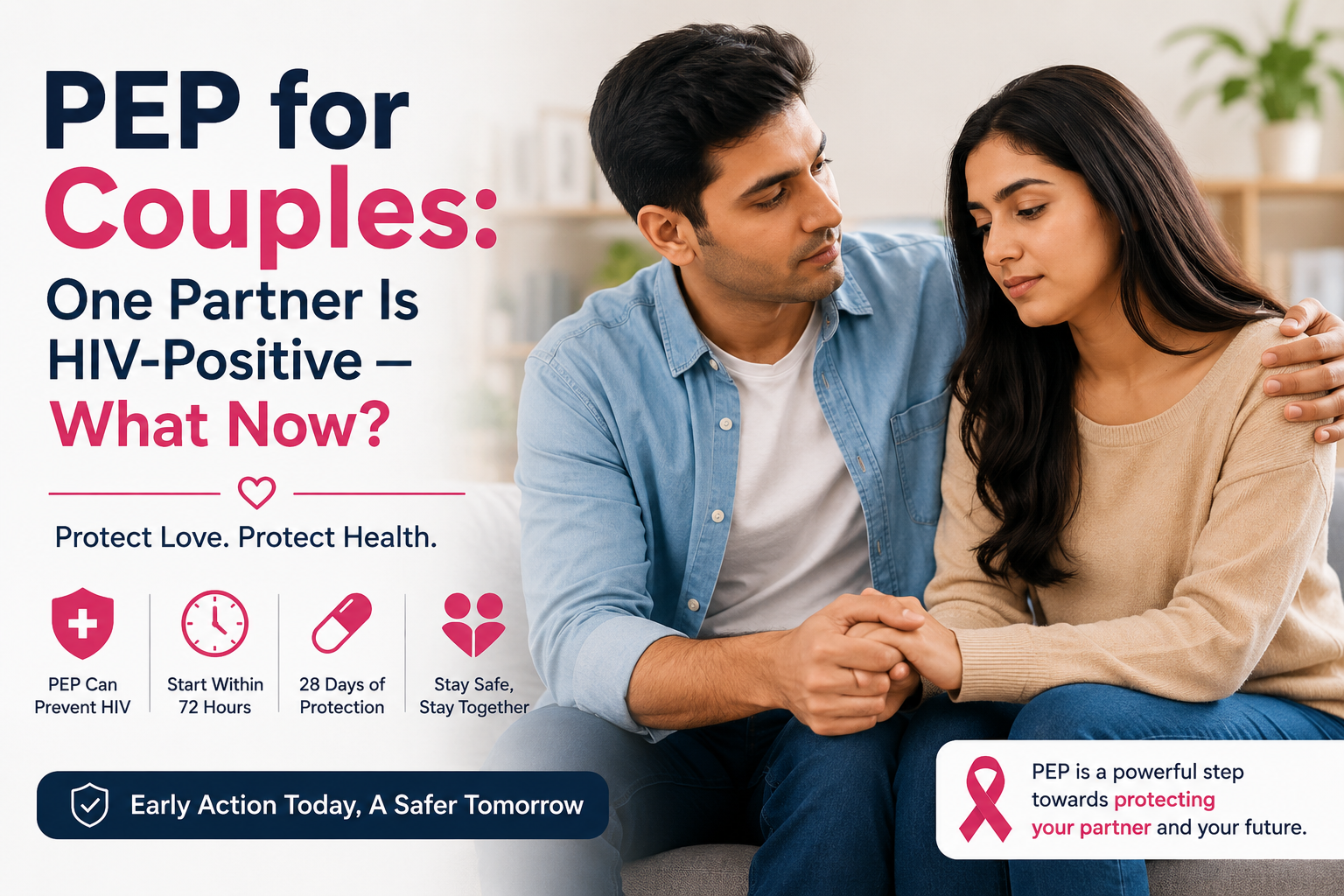
PEP for Couples: One Partner Is HIV-Positive, What Now?
Finding out that your partner has HIV is a moment that can feel like the ground has shifted beneath you. The fear, the uncertainty, the questions tumbling over each other - How did this happen? Are we safe? What about the sex we have already had? Can we still be together? These are all deeply human reactions, and they are ones I help patients and couples navigate every week in my clinic.
The good news - and I use the phrase deliberately - is that in 2026, a discordant couple (where one partner is HIV-positive and one is not) has more tools than ever before to protect both partners, maintain their relationship, and build a completely normal future together. This article is a calm, step-by-step guide to understanding your options.
Step 1: Immediate Assessment - Do You Need PEP?
The first question to answer is whether the HIV-negative partner has had a potential exposure to the virus within the last 72 hours. If you had unprotected sex with your partner before knowing their status, and that sex occurred within the past three days, you should contact a doctor immediately to discuss starting PEP.
PEP is a 28-day course of antiretroviral medication that, when started within 72 hours of exposure, significantly reduces the risk of HIV infection. The sooner it is started, the more effective it is - so please do not wait.
If the last potential exposure was more than 72 hours ago, PEP is no longer an option. In that case, the focus shifts to testing the HIV-negative partner and transitioning to a long-term protection strategy.
Step 2: Understanding the Real Risk Level
Before adjusting to worst-case scenarios, it is important to understand the actual risk of transmission in a discordant couple. The risk depends almost entirely on one factor: whether the HIV-positive partner is on effective ART.
If the HIV-positive partner is on ART and has an undetectable viral load, the scientific consensus is clear: they cannot sexually transmit HIV to their partner. This is the U=U (Undetectable = Untransmittable) principle, confirmed in multiple large studies including the landmark PARTNER2 study that followed 783 discordant couples through over 77,000 acts of condomless sex - and recorded zero HIV transmissions where the positive partner had an undetectable viral load.
If your HIV-positive partner is not yet on treatment, or has only recently started, some level of transmission risk exists. This is when PrEP for the negative partner becomes especially important.
Step 3: PrEP - The Long-Term Protection Strategy
For the HIV-negative partner in a discordant couple, PrEP (Pre-Exposure Prophylaxis) is the medical gold standard for ongoing protection. PrEP is a daily medication (typically tenofovir/emtricitabine) that, when taken consistently, reduces the risk of HIV infection through sex by over 99%.
PrEP is now available in India, and I strongly recommend it for the HIV-negative partner in any discordant relationship, particularly while the HIV-positive partner's viral load is still being established on treatment. Once the positive partner has maintained an undetectable viral load for six months or more on ART, the couple can discuss their ongoing prevention strategy with their doctor.
What About Having Children?
This is a question discordant couples ask me more than almost any other. The desire to have a family does not end with an HIV diagnosis, and nor should it. With proper medical guidance, discordant couples can have HIV-negative children safely.
For couples where the man is HIV-positive: if he is on effective ART with an undetectable viral load, conception through timed unprotected intercourse during the woman's fertile window carries extremely low risk. Sperm washing is another option. When the woman is pregnant, she may take ART throughout pregnancy and delivery to prevent mother-to-child transmission.
For couples where the woman is HIV-positive: she should be on ART before and throughout pregnancy. With proper treatment, the risk of mother-to-child transmission during pregnancy and delivery is reduced to less than 1%. Breastfeeding decisions will be made with the doctor's guidance.
Talking to Each Other: The Emotional Dimension
Beyond the medical protocols, discordant couples face real emotional and relational challenges. Disclosure, guilt, fear of rejection, and changes in intimacy are all common. I encourage couples to seek counseling - not because anything is wrong with your relationship, but because having professional support while navigating a significant health situation makes the process much easier.
Many of my patients who are in discordant relationships describe their partnerships as deeply loving, supportive, and ultimately strengthened by the honesty and communication that an HIV diagnosis required. With the right medical care, this is not the end of your relationship - it can be the beginning of a deeper one.
The Bottom Line for Discordant Couples
If your partner has HIV: get tested yourself, assess whether you need PEP immediately, start PrEP if appropriate, ensure your partner is on ART, and work toward a future where both of you are medically protected and emotionally supported. None of this is beyond reach. Thousands of Indian couples are living exactly this reality today.
Specialized Guidance for Discordant Couples
Navigating HIV as a couple requires specialist expertise. Dr. Yuvraj Monga provides confidential, compassionate counseling for both partners together or separately.
Consult Dr. Yuvraj Monga: WhatsApp +91 9999219128. Available 7 days a week. 100% confidential.